
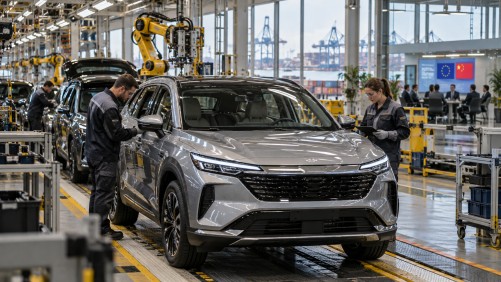
China and the European Union have reached an agreement aimed at managing the export of hybrid vehicles, a move expected to impact Chinese automakers by encouraging them to increase manufacturing within Europe. This development comes as Chinese hybrid vehicle exports to the EU have surged, reaching $7.5 billion in the first half of 2026, compared to $2.5 billion during the same period in 2025.
The popularity of plug-in hybrids has grown in Europe since the EU imposed additional tariffs on fully electric vehicles from China in 2024, with hybrids benefiting from an exemption. This has allowed Chinese manufacturers, such as BYD, SAIC, and Chery, to expand their market presence in Europe by meeting the demand for vehicles that integrate electric and conventional engines. However, the influx of imports has intensified competition for European automakers like Volkswagen.
While the specifics of the agreement, including potential import quotas and implementation rules, remain under negotiation, Chinese officials assert that the deal will permit continued export growth, whereas EU representatives anticipate a gradual reduction in imported vehicle volumes. The agreement has been welcomed by some industry leaders as a way to prevent escalating trade disputes.
Companies like Changan suggest that producing vehicles locally in Europe could help Chinese manufacturers retain market access. Plans for regional production are expected to progress, as analysts predict that larger Chinese automakers might establish more factories in Europe, though smaller companies could face challenges in expanding due to investment costs.
Although the deal may alleviate immediate tariff concerns, uncertainty lingers over future import restrictions, with the long-term effects dependent on the finalized rules and the strategic responses of both Chinese and European manufacturers in terms of pricing, production, and market positioning.